
Office Address
Email Address
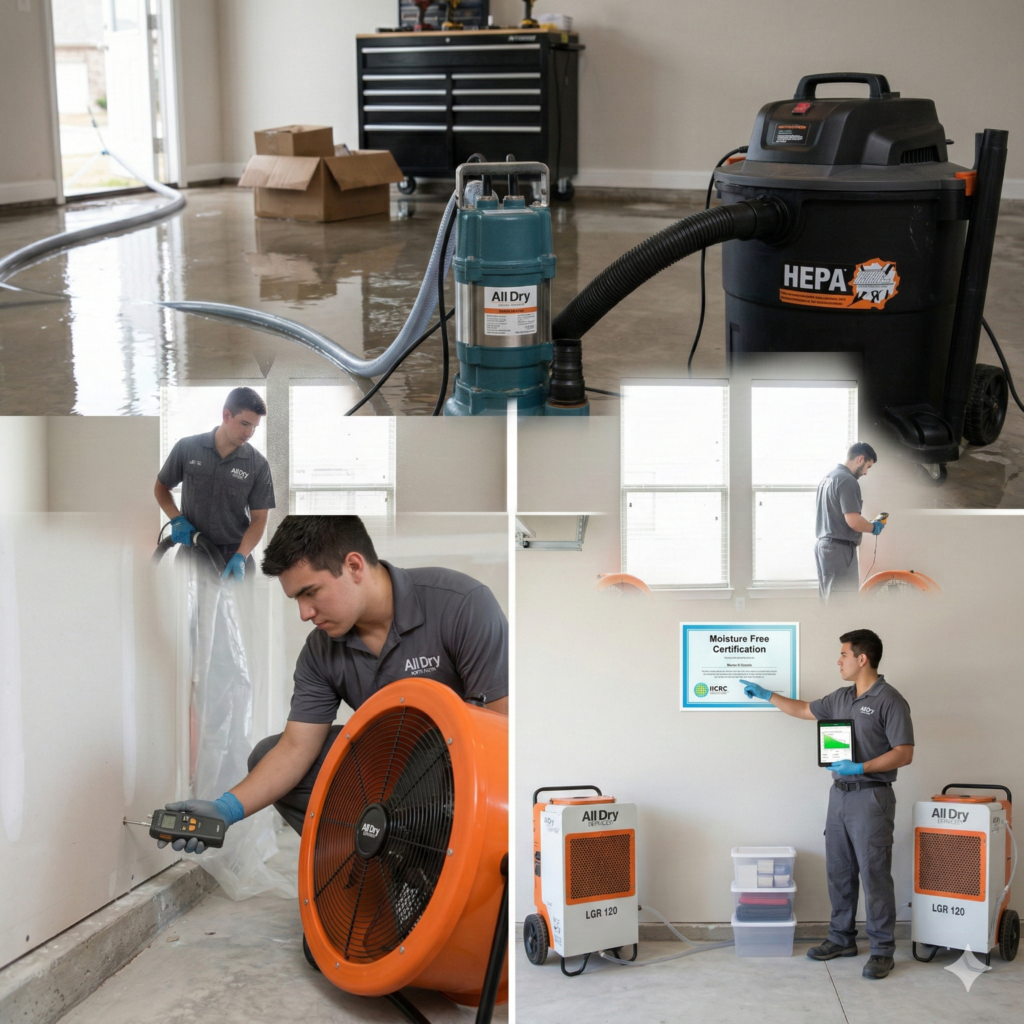
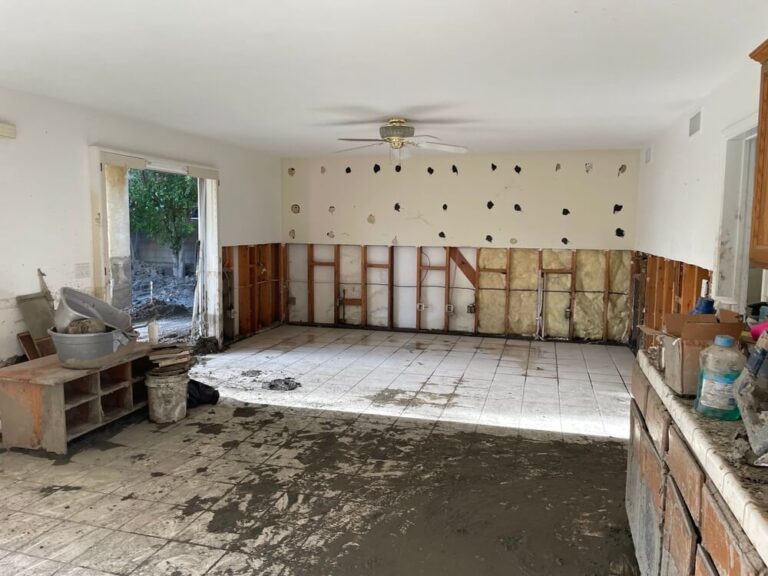
There is a specific kind of sinking feeling that hits when you open your garage door and see a shimmering lake where your car and storage bins should be. Whether it’s from a sudden Central Texas flash flood or a rogue pipe burst, the clock is officially ticking.
In our local climate, humidity is the enemy. If you don’t act within the first 24 to 48 hours, that “wet smell” will quickly turn into a full-blown mold colony. Here is the realistic, step-by-step guide to drying out your garage before the flood damage becomes permanent.
Before you grab a mop, you have to play detective. Water and electricity are a lethal combination.
Kill the Power: If your outlets or any appliances (like a secondary fridge or power tools) are touching the water, shut off the breaker for the garage immediately.
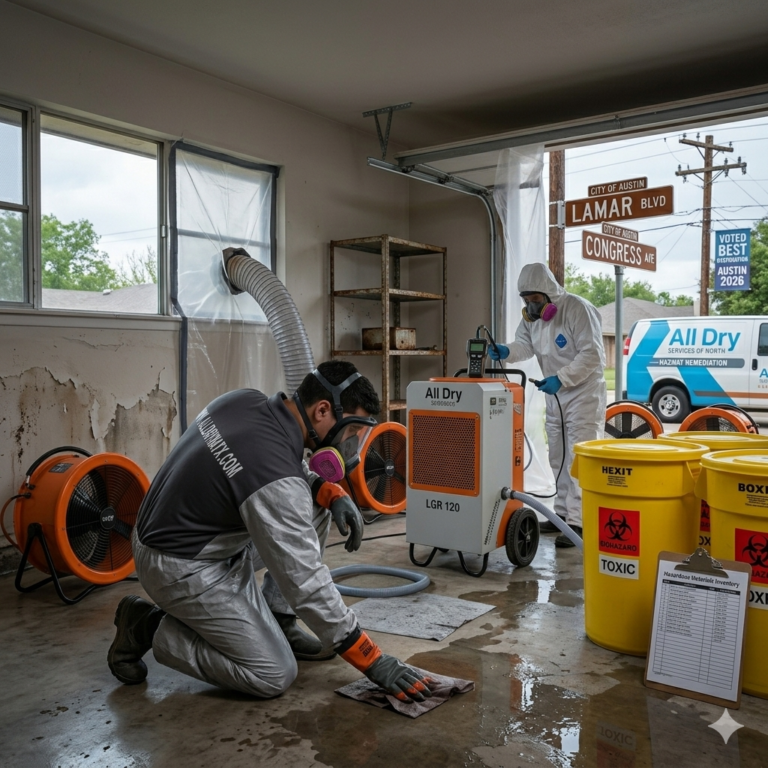
Check the Source: Is it clear rainwater, or is there a hint of a “sewage” smell? If it’s the latter, stop. This is Category 3 “Black Water” and requires professional-grade PPE to handle safely.
Document Everything: Before you move a single box, take 10–15 photos. Your insurance adjuster will need these to prove the extent of the initial “flood line.”
To dry a garage fast, you aren’t just removing liquid; you are managing psychometrics (the science of drying air).
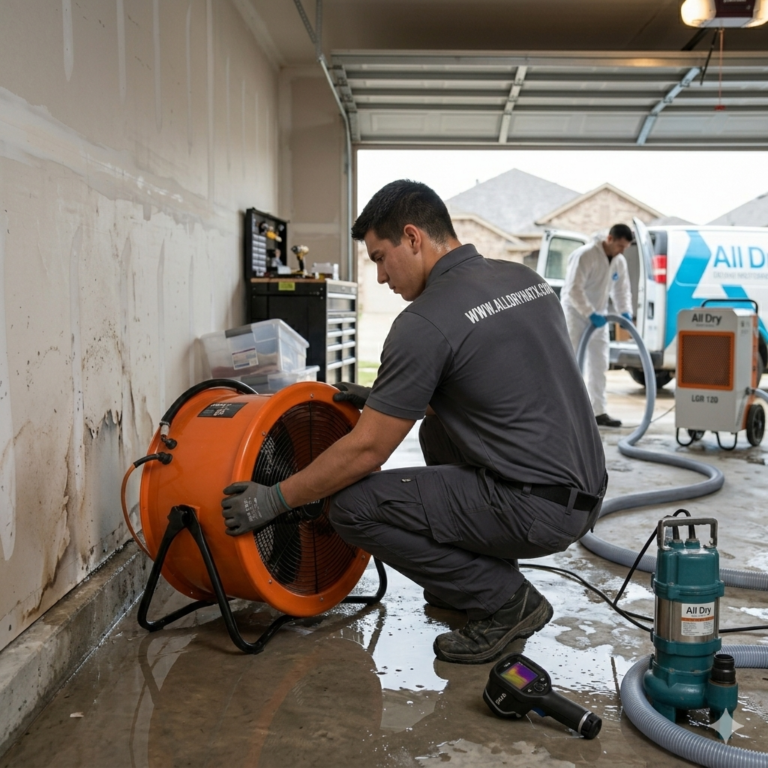
Mops are for spills; for a flood, you need a submersible pump or a high-capacity wet/dry vac.
Pro Tip: Don’t just vacuum the center. Focus on the edges where the drywall meets the floor. This is where water “wicks” upward into your wall studs.
In Round Rock, the outdoor humidity is often higher than the indoor air. If it’s a clear, dry day, open the garage door. If it’s raining or humid outside, keep the door shut and use a dehumidifier. Opening the door during a rainstorm actually adds more moisture to the concrete.
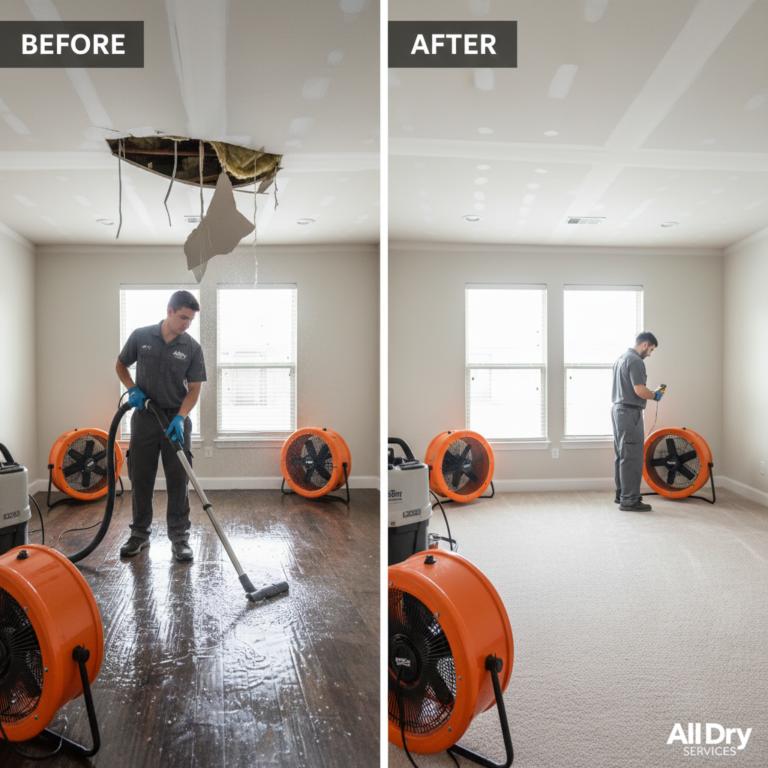
You need to break the “boundary layer” of saturated air sitting on top of your wet floor. Standard household fans won’t cut it. You need axial air movers tilted at a 45-degree angle toward the walls to create a “cyclone” effect.
Warm air holds more moisture than cold air. If it’s winter, running a space heater (safely!) can speed up evaporation, provided you have a dehumidifier running simultaneously to catch that evaporated water.
Most homeowners head to a big-box retailer like Home Depot to rent equipment. While this works for minor spills, there is a massive difference in performance:
Consumer Dehumidifiers: Usually pull 30–50 pints of water per day.
Industrial LGR Dehumidifiers: Used by teams like All Dry Services, these can pull 120+ pints per day and work in much lower humidity levels, ensuring the “deep” moisture inside the concrete is removed.
If your garage has finished drywall, a consumer fan will dry the surface, but the IICRC Standards warn that moisture trapped behind the wall can still trigger structural rot.
Not all floodwater is created equal. The industry classifies it into three categories:
Category 1 (Clean): From a supply line or rainwater. Safe for DIY.
Category 2 (Gray): Dishwasher or washing machine overflow. Contains some contaminants.
Category 3 (Black): Sewage, rising river water, or groundwater. Do not DIY this. This water contains pathogens that can cause serious illness.
In 2026, the national average for professional water restoration ranges from $1,300 to over $6,000 for a standard home. For a garage, you are often looking at:
Water Extraction & Drying: $800 – $2,500.
Mold Remediation (if delayed): $1,200 – $4,000+.
While local competitors like Servpro offer similar services, a local specialist can often provide a more tailored estimate based on Round Rock’s specific soil and foundation types.
Can I save wet cardboard boxes? Almost never. Cardboard is organic and porous—it’s the perfect “food” for mold. Take the items out, dry them, and toss the boxes.
Does concrete actually soak up water? Yes. Concrete is like a hard sponge. Even if it looks dry on top, moisture can remain inside for weeks, potentially warping any wood shelving or studs touching it.
How long does it take to dry completely? With professional equipment, 3 to 4 days. With household fans, it can take 7 to 10 days, which significantly increases the risk of mold.
If the water is deeper than an inch or has touched your drywall, don’t risk the structural integrity of your home. You can start the process by clearing out the debris, but call in the pros for the deep drying.
Need a professional eye on your garage? Contact All Dry Services of North Austin for a free moisture inspection. We’re in the neighborhood and ready to help 24/7.
Whether you’re a homeowner dealing with flooding, a business owner recovering from fire damage, or a property manager needing mold remediation, our certified team is ready 24/7 to bring your space back to life.
From water damage and fire restoration to mold removal and storm cleanup, we handle every type of property damage under one roof.
We offer competitive, transparent pricing with no hidden fees — quality restoration that fits your budget.
Disasters don’t wait, and neither do we. Our team is on call 24/7 to respond whenever you need us.
We stand by our work with industry-leading techniques and proven results, restoring your property to pre-damage condition.
Using advanced equipment and expert technicians, we deliver fast, reliable restoration that saves you time and money.
We make it easy to book service with flexible scheduling options that work around your life or business hours.